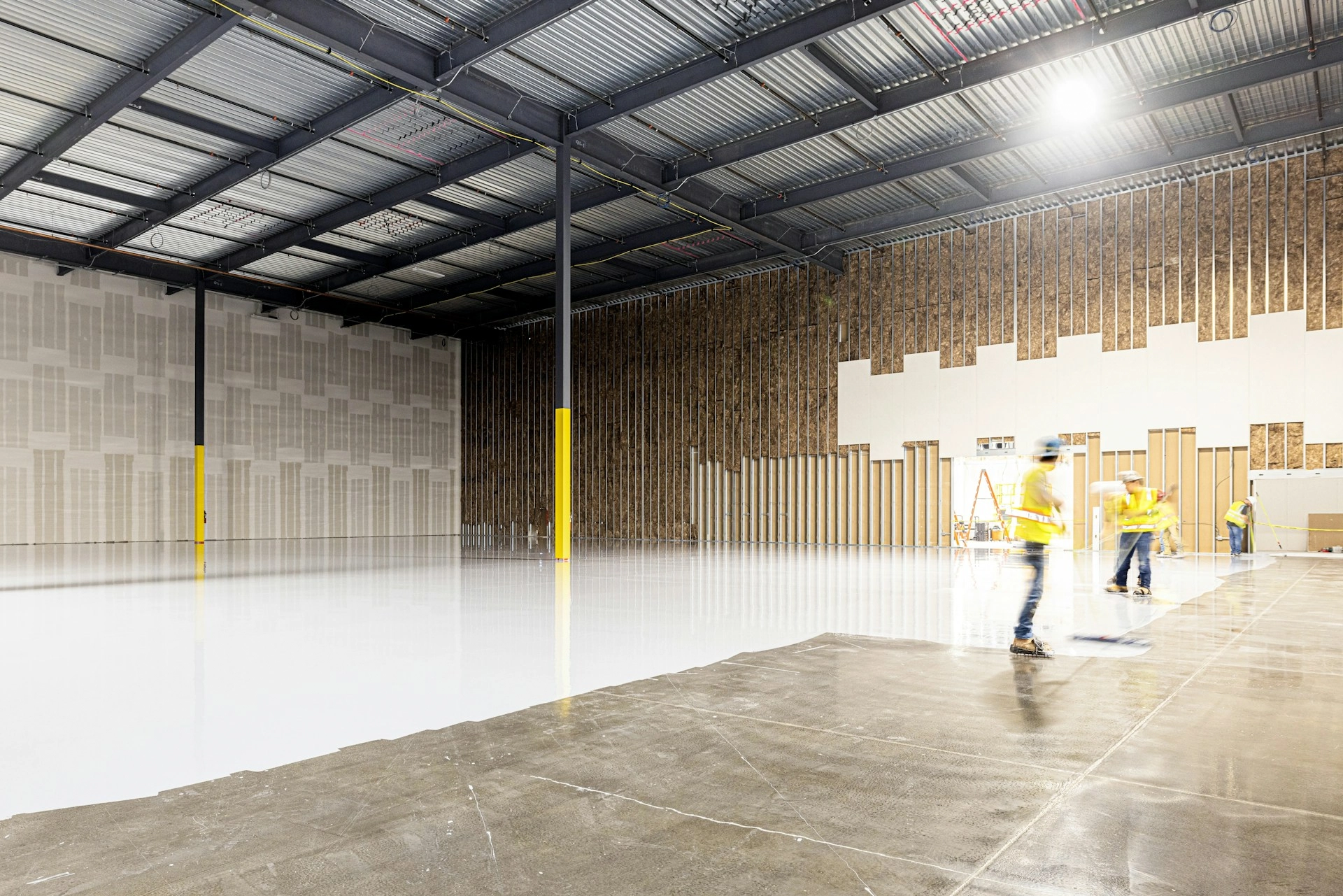
Epoxy flooring gets searched a lot in Singapore. The 700 monthly searches for the term are telling — people know the name, they have seen the glossy finish in showrooms or car workshops, and they want to know if it belongs in their home or business.
The short answer is that epoxy is a genuinely useful product in the right context. In the wrong context, it is one of the more frustrating mistakes a Singapore homeowner or business owner can make. Here is how to tell which situation you are in.
What Epoxy Flooring Actually Is
Epoxy is not a flooring material in the way that vinyl, timber or tiles are flooring materials. It is a surface coating — a two-part chemical system made from resin and hardener that is mixed on-site, applied to an existing floor, and cures into a hard, seamless surface layer.
You are not replacing your floor when you apply epoxy. You are coating it. The existing concrete or screed subfloor stays in place. The epoxy sits on top, bonded chemically to the substrate, creating a hard and often glossy surface that transforms the appearance of the space.
This distinction matters because the performance of an epoxy floor depends entirely on the condition of what is underneath it. A poorly prepared subfloor produces a failing epoxy coating within months. A properly prepared, dry, sound concrete surface produces one that lasts for years.
Where Epoxy Flooring Makes Sense in Singapore
Car Parks and Workshops
This is epoxy’s home territory. Car park floors, vehicle workshops, motorcycle bays and loading docks all benefit from epoxy’s resistance to vehicle oil, chemical spills, abrasion from tyres and heavy loads. The seamless surface is easy to hose down. The marking options — lane lines, bay numbers, safety zones — are clear and durable.
Commercial Kitchens and F&B Back-of-House
For commercial kitchen floors, epoxy competes directly with homogeneous vinyl. Both are seamless, chemical-resistant and easy to clean. Epoxy has the advantage of being applied to an existing screed without raising the floor height — useful when kitchen equipment clearances are tight. It also handles extreme temperature variation from cooking equipment better than some vinyl products.
Industrial and Manufacturing Facilities
Factories, warehouses, production lines and industrial storage areas use epoxy because of its load-bearing capacity, chemical resistance and ability to be specified with anti-slip aggregate for safety compliance. For Singapore’s electronics and biomedical manufacturing sector, ESD-conductive epoxy coatings are available — though our purpose-built ESD vinyl flooring often provides better long-term performance and easier maintenance.
Retail Showrooms and Commercial Spaces
High-gloss epoxy creates a striking visual effect in showrooms and retail spaces. It reflects light, appears seamless and photographs well. For a Singapore F&B or retail concept where the floor is part of the brand aesthetic and budget is a consideration, epoxy is a cost-effective option — though it requires more careful maintenance than vinyl to retain that high-gloss appearance.
Where We Would Caution Against Epoxy
HDB and Condo Home Floors
Epoxy over existing HDB floor tiles is technically possible but carries significant risk. Singapore’s humidity causes moisture to migrate through concrete slabs — and moisture trapped beneath an epoxy coating causes delamination, bubbling and failure. This is one of the most common epoxy failure modes in Singapore residential applications.
For HDB bedrooms, living rooms and kitchens, SPC vinyl flooring or LVT is a more reliable choice. Both are genuinely waterproof throughout their full thickness, install cleanly over existing tiles without moisture risk and provide better acoustic performance underfoot.
Bathrooms and Wet Areas
Epoxy in residential bathrooms is a popular idea that often disappoints in practice. Water ingress at grout lines or tile edges, moisture from the slab and the humid Singapore bathroom environment all stress the epoxy-substrate bond over time. Professional-grade bathroom epoxy applied correctly can work, but the maintenance demands and failure risks are higher than most homeowners expect.
Anywhere With Direct Outdoor Exposure
Standard epoxy is not UV-stable. In Singapore’s intense equatorial sun, outdoor epoxy floors chalk, fade and deteriorate rapidly. For balconies, terraces and pool surrounds, composite decking or UV-stable vinyl are the appropriate specifications.
The Moisture Problem in Singapore
This deserves its own section because it is the cause of most epoxy failures on the island.
Singapore’s high water table and persistent ground moisture mean that concrete slabs — particularly in older buildings and ground floor units — often have higher moisture vapour emission rates than the epoxy coating can tolerate. If moisture vapour migrates upward through the slab faster than the epoxy allows it to escape, pressure builds between the coating and the substrate and the bond fails.
Proper moisture testing before application is non-negotiable. The standard test is a calcium chloride test or relative humidity probe reading within the slab itself — not just a surface damp meter reading. If moisture levels are too high, either the slab needs to be dried down properly first or the specification needs to include a moisture barrier primer rated for the measured emission level.
Epoxy vs Vinyl: The Honest Comparison
For commercial and industrial applications where the subfloor is sound, properly prepared and moisture-controlled, epoxy is a competitive option with specific advantages.
For residential Singapore applications and most commercial spaces where subfloor moisture is a variable, vinyl-based products are more forgiving, more reliable and easier to live with long-term. They do not depend on substrate perfection in the same way. They can be replaced without grinding back to bare concrete. And they provide acoustic performance that epoxy, being a hard coating over hard concrete, cannot match.
Our guide on vinyl vs tiles covers the broader comparison between hard surface options if you are weighing up materials for a renovation project.
What Good Epoxy Installation Involves
If epoxy is the right choice for your space, the quality of the installation determines everything. The steps that cannot be skipped:
Surface preparation — mechanical grinding to open the concrete surface, remove laitance and create a profile for adhesion. Shot blasting for large commercial areas.
Moisture testing — calcium chloride or in-slab RH testing. Application only when emission rates are within the coating system’s tolerance.
Primer coat — a penetrating epoxy primer that seals the surface and establishes the bond layer.
Body coat — the main epoxy layer or layers, applied to thickness.
Top coat — a polyurethane or epoxy topcoat for chemical and abrasion resistance. For wet areas, a slip-resistant aggregate broadcast into the topcoat before it cures.
Cure time — full cure typically requires 7 days before heavy traffic or chemical exposure, even when surface dry in 24 hours.
Singapore’s BCA Green Mark framework recognises low-VOC coating systems for commercial interior applications — worth noting if your project is pursuing green certification.
Talk to Us About Your Flooring
Epoxy is one of many options we can advise on — though we specialise in vinyl-based flooring systems. If epoxy is the right answer for your project, we will tell you. If it is not, we will explain why and show you what is.
Get in touch or call +65 8299 7185. We are at WCEGA Tower, 21 Bukit Batok Crescent #12-78, Singapore. Open 7 days a week.