Hotel flooring in Singapore is a very specific brief. The floor has to look like a million dollars on day one. It has to still look good after thousands of room turnovers, housekeeping trolleys, suitcase wheels, and the full range of guests. It has to clean up quickly between guests. And it has to do all of this quietly — because sound transmission between guest rooms is a complaint that kills reviews.
We work with hotel operators and serviced apartment managers across Singapore on flooring specification and supply. This is what we have learned about what actually matters.
The Hospitality Brief Is Different From Every Other Commercial Sector
Offices care about durability and acoustics. Retail cares about aesthetics and foot traffic. Healthcare cares about hygiene and chemical resistance.
Hotels care about all of these simultaneously — and add one more variable: guest experience. The floor is part of how a guest feels about their room, their arrival experience, and whether they would recommend the property.
That is why flooring decisions in hospitality cannot be made purely on technical specification. The material choice has to support the brand positioning of the property — from the entrance moment through to the room experience.
Zone by Zone: What Works Where
Lobby and Reception
The lobby sets the guest’s entire perception of the property. It is also one of the highest-traffic areas in the building — guests, visitors, luggage trolleys, concierge movement, and cleaning staff all converge here.
For hotel lobbies, large-format commercial-grade LVT in premium stone finishes — Carrara marble look, travertine, polished concrete — creates the visual impact appropriate for mid-range and upscale Singapore properties. Specify a 0.55mm or 0.7mm wear layer for lobby traffic volumes.
For truly luxury properties, natural stone tiles remain the benchmark — but they come with significant ongoing maintenance costs. High-quality LVT is now genuinely close to the visual standard of natural stone at a fraction of the total cost of ownership.
Guest Room Corridors
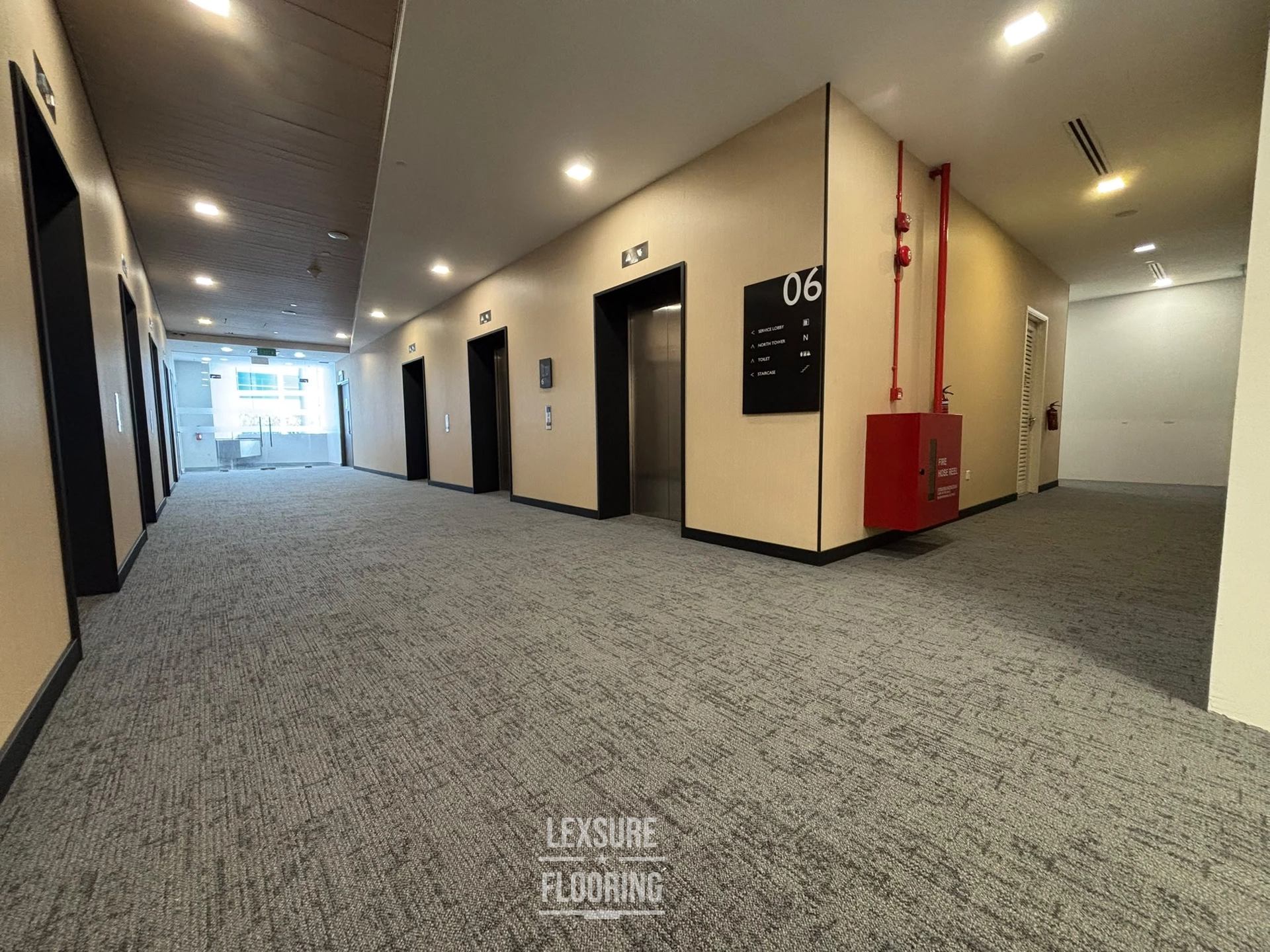
Corridors take more daily traffic than individual rooms and need a floor that holds up to luggage wheels and trolleys without developing scuff marks along the centre line.
Corridor floors in Singapore hotels are typically LVT in a wood or neutral stone finish, with glue-down installation to eliminate any hollow underfoot sound. The acoustic performance of a glue-down floor is significantly better than a floating installation — in hotel corridors where guest noise sensitivity is high, this matters.
Guest Rooms
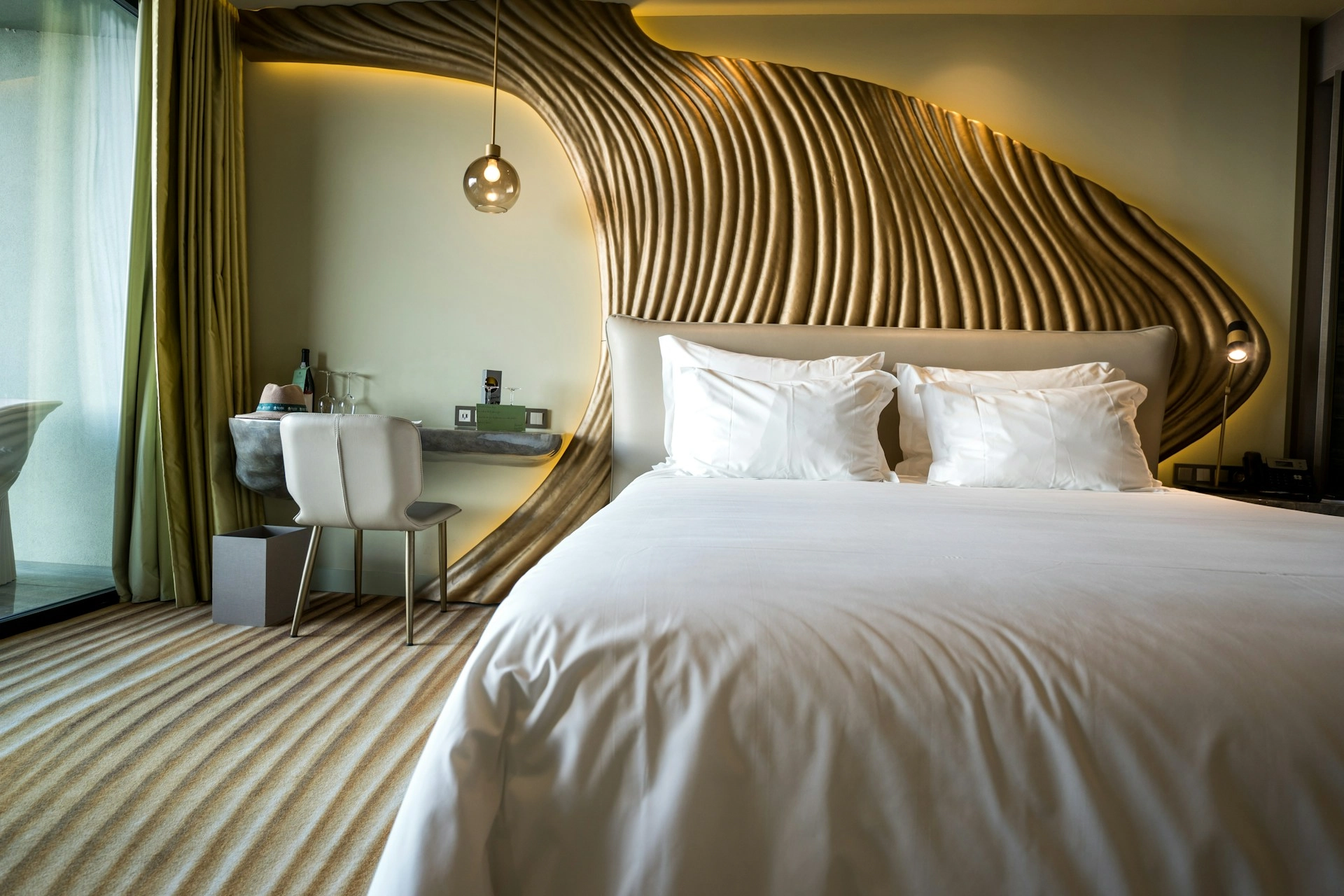
Guest room flooring needs to feel premium, be easy to clean between turnovers, and transmit minimal noise to adjacent rooms and floors below. Carpet has traditionally dominated Singapore hotel rooms — but it is increasingly being replaced by hard flooring with area rugs.
The driver is practical: hard flooring cleans faster and more thoroughly between guests, has no allergen concerns, and lasts significantly longer between refurbishment cycles. The guest experience trade-off is some loss of acoustic softness — which is why area rugs over LVT or SPC is the most common current approach in Singapore’s mid-market and upscale hotel segment.
For the flooring itself, LVT in warm wood finishes works well in most room sizes. In compact Singapore hotel rooms, lighter tones help the space feel larger. Herringbone plank layouts in the entryway and bathroom transition are increasingly popular in boutique and lifestyle properties.
Hotel Bathrooms
Hotel bathroom floors need to be fully waterproof, slip-resistant for wet conditions, and genuinely hygienic. LVT with welded seams or specialist wet-area adhesive installation handles moisture without grout maintenance. Slip-resistant surface textures are available across the LVT range for wet-area specification.
All-Day Dining, Bars, and F&B Areas
Hotel F&B flooring shares the requirements of restaurant floors — fully waterproof, slip-resistant in service areas, and visually on-brand in dining spaces. Our restaurant flooring guide covers F&B specification in detail.
Outdoor Areas and Pool Decks
Singapore hotel pool decks and outdoor terraces need UV-stable, slip-resistant, and waterproof surfaces. Composite decking is our recommendation for pool surrounds and outdoor terrace areas — weather-resistant, splinter-free, and comfortable for bare feet in Singapore’s heat.
Specifying for the Full Refurbishment Cycle
Singapore hotels typically refurbish guest rooms every 7–12 years. Specifying commercial-grade LVT with a 0.55mm or 0.7mm wear layer means the floor survives to the next refurbishment cycle rather than needing mid-cycle replacement. That is a significant cost consideration across a property with hundreds of rooms.
The right product, correctly installed on a properly prepared subfloor, should not need attention between scheduled refurbishments beyond routine cleaning.
Our Approach for Hotel and Serviced Apartment Projects
We understand the operational realities of hotel refurbishments — work happens in phased sections while the property remains operational, rooms have to be turned around quickly, and timelines are tied to low-occupancy periods.
Our team handles installation after-hours and in phased blocks, with full project management from specification through to handover. For green-certified hotel developments, our materials can be specified to meet BCA Green Mark indoor air quality and materials criteria.
Let Us Talk About Your Hotel Project
Get in touch to arrange a free site assessment and specification discussion. Call us on +65 8299 7185 or email [email protected].
We are at 25 Bukit Batok Crescent #01-04, Singapore. Open 7 days a week.