A restaurant floor works harder than almost any commercial surface in Singapore. It handles constant foot traffic from staff and customers, frequent spills of oil, water, and food, daily mopping with commercial cleaning agents, heavy kitchen equipment, and the need to look consistently clean and inviting — often at the same time.
Getting restaurant flooring in Singapore right is both a safety decision and a business decision. The wrong floor creates slip hazards for staff, requires expensive frequent replacement, and communicates the wrong message about your F&B establishment.
Lexsure Flooring has experience supplying and installing flooring for Singapore’s diverse F&B sector — from artisan cafés and themed restaurants to institutional food courts and commercial kitchen facilities. This guide covers what works and why.
The Specific Demands of F&B Flooring in Singapore
Restaurant and F&B environments impose a combination of demands that few other commercial spaces match:
Slip Resistance
F&B kitchens and service areas are among the highest-risk environments for slip-and-fall accidents in Singapore’s commercial sector. Floors become wet constantly — from spills, mopping, condensation, and food preparation. The flooring must provide reliable traction for staff moving quickly in a busy service environment, even when the floor is wet.
For kitchen areas, Singapore’s Workplace Safety and Health guidelines and the Ministry of Manpower’s slip hazard standards are relevant considerations. MOM’s workplace safety guidelines set out employer obligations for safe floor surfaces — flooring specified for commercial kitchens must meet appropriate slip-resistance ratings for wet conditions.
Oil and Chemical Resistance
Commercial kitchen floors are exposed to cooking oil, grease, acidic food spills, strong alkaline degreasers, and sanitising chemicals — often multiple times in a single day. The flooring surface must resist chemical degradation from this combination. Many flooring types that perform well in dry commercial environments fail rapidly in kitchen conditions.
Full Waterproofing
F&B floors — front-of-house and back-of-house — must be completely waterproof throughout. Moisture that reaches the subfloor in a kitchen environment creates conditions for mould, bacteria, and structural deterioration.
Durability Under Equipment and Trolley Traffic
Commercial kitchens use heavy equipment — preparation benches, cooking ranges, refrigeration units — and trolleys for food and supply movement. The floor must handle the load of this equipment without denting, cracking, or developing settlement issues.
Hygiene and Cleanability
Singapore’s National Environment Agency (NEA) sets strict hygiene standards for licensed food establishments. Flooring must be easy to clean thoroughly, non-porous, and resistant to the accumulation of food residue and bacteria. Grout lines — standard in tile installations — are the enemy of commercial kitchen hygiene: they trap food residue, absorb cleaning chemicals, and are extremely difficult to clean to a genuinely sanitary standard.
Best Flooring Options for Singapore F&B Establishments
Homogeneous Vinyl Sheet — The Kitchen Standard
For commercial kitchen floors in Singapore restaurants and food courts, homogeneous vinyl sheet flooring with thermally welded seams is the professional specification. The seamless, joint-free surface eliminates the hygiene issues of grout and the water ingress risk of tile joints. It is chemical-resistant, fully waterproof, easy to clean to a hygienic standard, and significantly more comfortable for kitchen staff to stand on for extended periods than tiles.
Available in slip-resistant surface grades appropriate for wet commercial kitchen conditions, with a range of colours and finishes that meet NEA cleanliness requirements.
Commercial LVT — For Front-of-House Dining Areas
Commercial-grade LVT in glue-down format is the most popular choice for Singapore restaurant dining floors. It creates a premium, warm aesthetic — wood-look and stone-look finishes both work well in different dining concepts — while handling the daily cleaning routine and moderate spill exposure of a front-of-house environment.
Specify a minimum 0.55mm wear layer for restaurant dining areas, and 0.7mm for very high-traffic casual dining or food court concepts. Glue-down installation eliminates the hollow underfoot sound of floating installations and removes any risk of plank movement under heavy dining chairs and tables.
The Transition Zone: Kitchen to Dining
The floor specification for the kitchen and the dining area will typically differ. This transition is managed with appropriate edge trims and threshold strips. Where possible, Lexsure recommends a flush transition between zones for both practical and aesthetic reasons — avoiding trip hazards and maintaining a clean visual line.
Restaurant Flooring by Concept Type
Fine Dining and Premium Restaurants
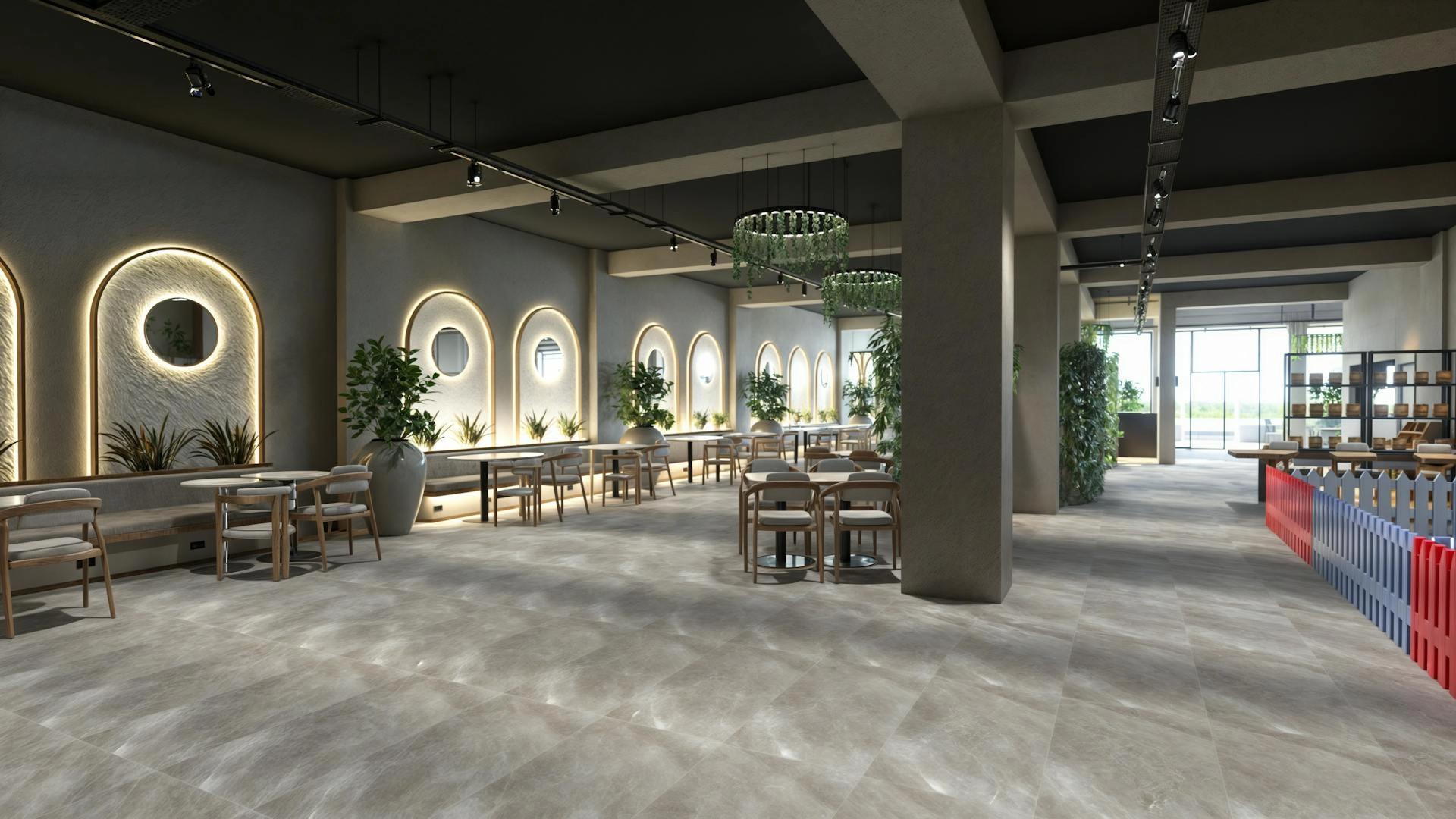
The dining floor is part of the experience. Large-format LVT in marble or premium stone looks creates the expected premium aesthetic. Warm wood-look LVT plank flooring is equally effective in fine dining establishments aiming for an intimate, sophisticated atmosphere rather than a formal one.
Casual Dining, Cafés, and Western Concepts
Concrete-look LVT in grey or warm buff tones is one of the most popular choices for Singapore’s café and casual dining market. It reads as contemporary and on-trend while being highly practical and easy to maintain. Wide-plank warm oak LVT works well in café concepts aiming for a warm, Scandi-influenced aesthetic.
Asian Hawker and Traditional Concepts
For hawker-inspired or traditional restaurant concepts, non-slip homogeneous vinyl in neutral or earth tones throughout — including dining areas — provides a practical, hygienic, and culturally appropriate aesthetic that is easy to maintain under high-volume service conditions.
Food Courts and Institutional Catering
Homogeneous vinyl throughout — seamlessly welded, in light neutral tones that communicate cleanliness to customers and simplify cleaning for operations staff. Durability and hygiene compliance take priority over design in institutional F&B environments.
Installation Considerations for Singapore Restaurants
- NEA licensing compliance — floor specification should be confirmed as appropriate for NEA food establishment licensing requirements before installation.
- Thermal welding for kitchen areas — seamless joints are non-negotiable in commercial kitchen environments. Lexsure’s team has the equipment and expertise for commercial vinyl thermal welding.
- After-hours installation — restaurant flooring installations are typically scheduled overnight or on closure days to avoid disrupting service.
- Drain integration — kitchen floor installations must account for existing floor drain positions. Lexsure’s team coordinates drain integration during installation.
Why Singapore F&B Operators Choose Lexsure
- F&B sector experience — we understand the hygiene, safety, and operational requirements of Singapore’s licensed food establishment sector.
- Commercial-grade product range — homogeneous vinyl, commercial LVT, and specialist anti-slip surfaces in commercial wear layer specifications.
- Thermal welding capability — essential for seamless kitchen floor installations.
- After-hours scheduling — we work around your service hours.
- Direct OEM supply — competitive commercial pricing without distributor markups.
Get a Free F&B Flooring Consultation
Contact Lexsure Flooring to discuss your restaurant or F&B flooring project. We offer free site assessments and detailed proposals for F&B fit-outs across Singapore.
Visit us at 25 Bukit Batok Crescent #01-04, Singapore, call +65 8299 7185, or email [email protected]. Open 7 days a week.