The floor under a Singapore data centre or mission-critical facility is not passive infrastructure. It is an active component of the cooling system, the cable management architecture and the electrical safety framework of the space. Getting the raised floor specification wrong creates operational constraints that are expensive and disruptive to address after the facility is commissioned.
This guide is written for facility managers, data centre designers and IT infrastructure teams in Singapore who are specifying or evaluating raised floor systems. It covers the panel types, load ratings, ESD specifications and installation considerations that determine whether a raised floor system performs correctly for its intended use case.
HPL Panels: The Standard Commercial Specification
High Pressure Laminate (HPL) is the surface material of choice for raised floor panels in Singapore’s data centres, corporate offices and technical facilities. It is hard, dimensionally stable, resistant to surface wear and available in finishes appropriate for professional technical environments.
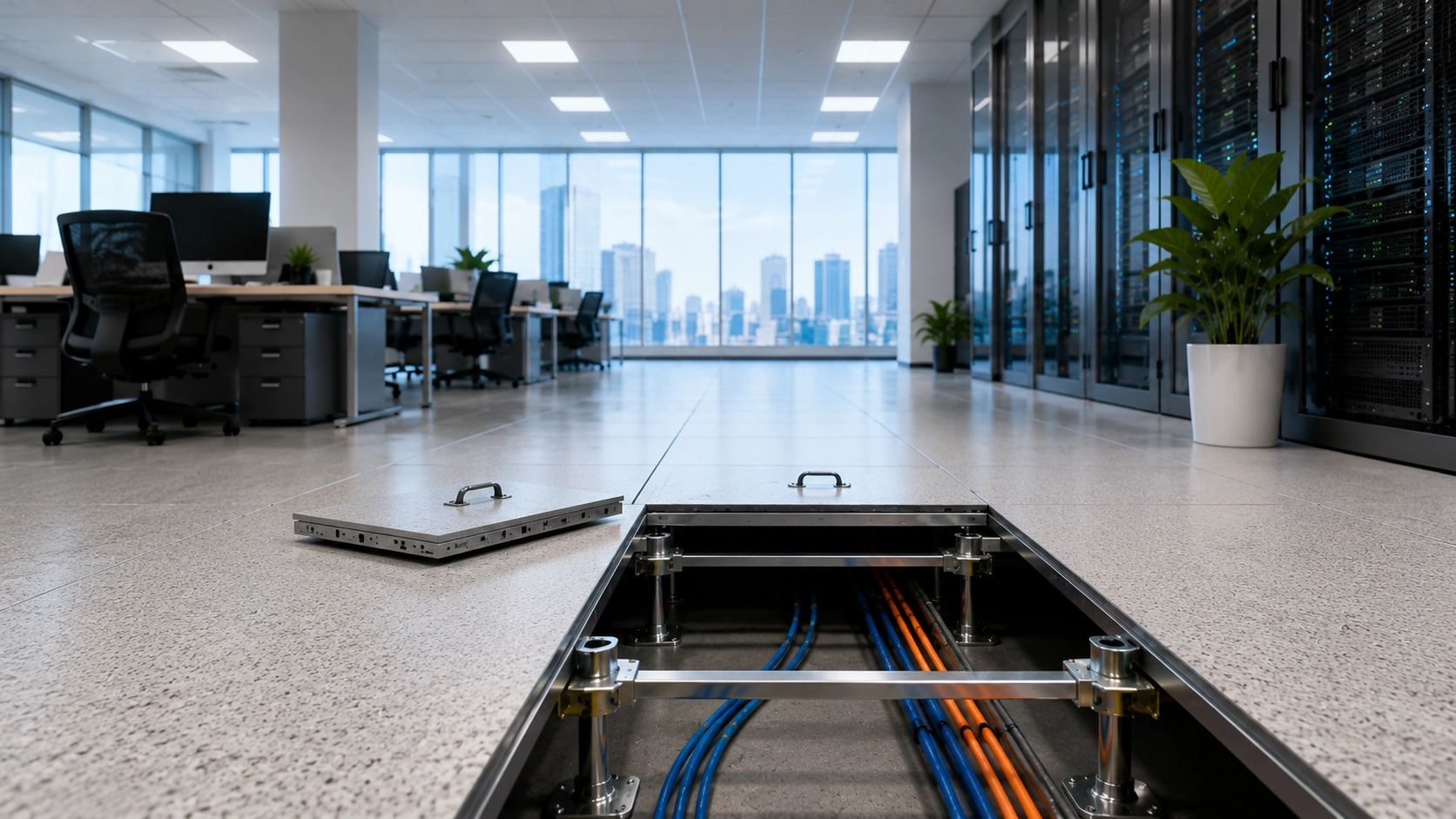
An HPL raised floor panel consists of a structural core, typically a calcium sulphate (gypsum) compound or steel-reinforced wood composite, with an HPL surface laminate bonded to the top and a balancing laminate on the underside. The HPL surface carries the mechanical and aesthetic load of the walking surface. The core provides the structural rigidity and load distribution that the pedestal system transfers to the slab.
Calcium sulphate core panels are the standard for Singapore data centres. The material provides excellent load distribution, does not expand or contract significantly with temperature changes and does not support mould growth. Steel-encased variants provide higher load capacity where equipment density demands it.
Our HPL Raised Floor product range covers the panel specifications, core types and surface finish options we supply for Singapore projects, with load ratings, void height options and ESD variants.
ESD Specification for Data Centres and Technical Facilities
In Singapore’s data centres, electronics manufacturing facilities and cleanrooms, the raised floor surface must not allow static charge to accumulate. Standard HPL surfaces are electrical insulators. A person walking across a standard HPL raised floor in a data centre builds up a static charge that discharges to equipment on contact.
ESD-rated raised floor panels address this with a conductive or dissipative HPL surface treatment connected to the building’s earthing system through the pedestal grid. The combination of a grounded pedestal grid and a conductive or dissipative panel surface provides a continuous path for static charge to drain to earth rather than accumulate and discharge.
Two specifications apply:
Conductive panels achieve a surface resistance below 10 to the power of 6 ohms to earth. These drain static very rapidly and are appropriate for the most sensitive environments.
Dissipative panels achieve a surface resistance between 10 to the power of 6 and 10 to the power of 9 ohms to earth. The controlled, slower drain rate is the standard specification for most Singapore data centre and IT facility applications.
The pedestal grid must be connected to a building earth point to complete the grounding circuit. Our installation includes the earth bonding connections between the pedestal grid and the facility’s earthing system, with post-installation resistance testing to confirm performance.
This integrates with our broader ESD flooring range for environments where the entire floor system requires electrostatic control.
Load Ratings: Where Most Projects Are Under-Specified
Raised floor load ratings are expressed in three ways that are often confused or conflated in specifications:
Concentrated load: the maximum weight applied over a small contact area, typically a 25mm square or 50mm square test pad. This is the relevant rating for equipment legs, jack stands and point loads from heavy equipment placement.
Rolling load: the maximum load that can be rolled across the floor on a wheel, tested at a specific wheel diameter. This is relevant for server rack transportation and heavy equipment moves during fit-out and subsequent equipment changes.
Ultimate load: the load at which the panel fails structurally. The working load rating is a fraction of the ultimate load, with the safety factor determined by the applicable standard.
For Singapore data centres, the relevant standard for most facility types is the raised floor load ratings specified in EN 12825. The typical specification for a standard data centre floor is 12kN/m2 distributed load with a concentrated load rating of 4.5kN.
Where full equipment racks are loaded to capacity, the concentrated load at each rack leg can exceed what standard panels are rated for. Calculate the actual equipment load per rack, divide by the number of contact points and compare against your panel’s concentrated load rating. Do not assume the standard specification is adequate without checking the actual rack weights.
Void Height and Airflow Planning
The void height between the structural slab and the underside of the raised floor panels determines the static pressure available for underfloor cooling air distribution. This is a critical design parameter for data centres using CRAC or CRAH-based cooling.
Singapore data centre operators typically specify 450mm to 600mm void height for modern facilities with significant cooling loads. Older Singapore facilities built with 300mm void heights face ongoing operational challenges as equipment density increases.
The pedestal height determines the void height. Adjustable pedestals allow the void height to be set precisely during installation and fine-tuned if the slab has minor level variation. Lexsure supplies adjustable pedestal systems for the full range of void heights required for Singapore data centre and commercial office applications.
Perforated floor tiles are placed in the cold aisles in front of equipment racks to direct cooling air upward through the raised floor void into the equipment intake. The percentage of open area in the perforated tiles is selected based on the volume of cooling air required and the available static pressure in the void. This is a thermal design question that should be resolved with your cooling system supplier before the raised floor tile layout is finalised.
Maintenance Access and Panel Management
One of the primary advantages of raised flooring over fixed flooring is the ability to access the void for cable management, cooling system maintenance and infrastructure changes without structural work.
Panel lifters are required to remove floor panels safely. Our supply includes appropriate panel lifting equipment for the panel format being installed.
Panel registration is the practice of tracking which panel is in which location. In a large data centre with thousands of panels, this becomes relevant when panels are removed and replaced over time. Maintain a panel layout drawing that is updated whenever panels are permanently relocated.
Cable management within the void should follow a structured plan from the outset. Unmanaged cables in the raised floor void restrict airflow, create maintenance hazards and become progressively harder to trace as the facility scales. Plan cable routes and use cable management trays in the void from initial fit-out.
Singapore’s BCA Green Mark for Data Centres includes criteria related to cooling efficiency and infrastructure flexibility that directly intersect with raised floor design. Facilities pursuing Green Mark certification should align their raised floor specification with the cooling system design from the earliest stage of the project.
Discuss Your Raised Floor Project
Contact our team to discuss HPL raised floor specification for your Singapore data centre, server room or critical facility. We supply and install HPL raised floor systems with ESD options and post-installation testing.
Call +65 8299 7185. WCEGA Tower, 21 Bukit Batok Crescent #12-78, Singapore. Open 7 days.