Singapore has hundreds of indoor basketball courts. They sit in school sports halls, community clubs, condominium multi-purpose rooms, private gyms and public sports centres. Most of them are in constant use. And a significant proportion of them have floors that are either under-specified for the demands placed on them or in need of resurfacing.
If you are planning a new indoor basketball facility or resurfacing an existing court, the floor specification is the most consequential single decision you will make. Everything else in the facility serves the floor or depends on it.
What Basketball Demands From a Court Surface
Basketball is a high-impact, high-velocity sport. Players run at full speed, stop suddenly, jump and land repeatedly. Each landing generates impact forces several times body weight. A floor that does not absorb some of this energy transmits it directly into players’ joints over the course of a game.
This is not just a performance issue. It is a safety and long-term health issue. The reason sports floor standards exist is not to improve the spectacle of the game. It is to reduce cumulative injury risk to the players on the surface every day.
The International Basketball Federation (FIBA) maintains standards for court surfaces used in sanctioned competition. For surfaces used in FIBA-affiliated competition in Singapore, FIBA approval is required. For recreational, school and community courts, FIBA approval is not mandatory but the underlying performance requirements are the right benchmark for any court where people play seriously.
The Key Performance Criteria
Shock absorption of at least 25 per cent. This reduces the physical stress on knees, ankles and the lower back from landing, stopping and changing direction. For courts that see daily use by school students and club players over years, this matters significantly.
Ball bounce between 90 and 100 per cent of the reference value on concrete. Consistent ball response is fundamental to basketball. A surface that produces variable bounce changes the game and disadvantages players who have developed muscle memory on consistent surfaces.
Friction in the correct range. Insufficient friction causes slipping during fast movement. Too much friction causes abrupt stops that transfer stress to the knee joint. Basketball shoes are designed for a specific friction range. Court surface specifications are designed to match.
Vertical deformation of less than 2.3mm under standard test loads. This prevents visible deflection under player weight and ensures the court surface maintains its geometry over its service life.
Sports Vinyl vs Timber for Singapore Basketball Courts
The choice between sports vinyl and timber for a Singapore indoor basketball court is one we get asked about regularly.
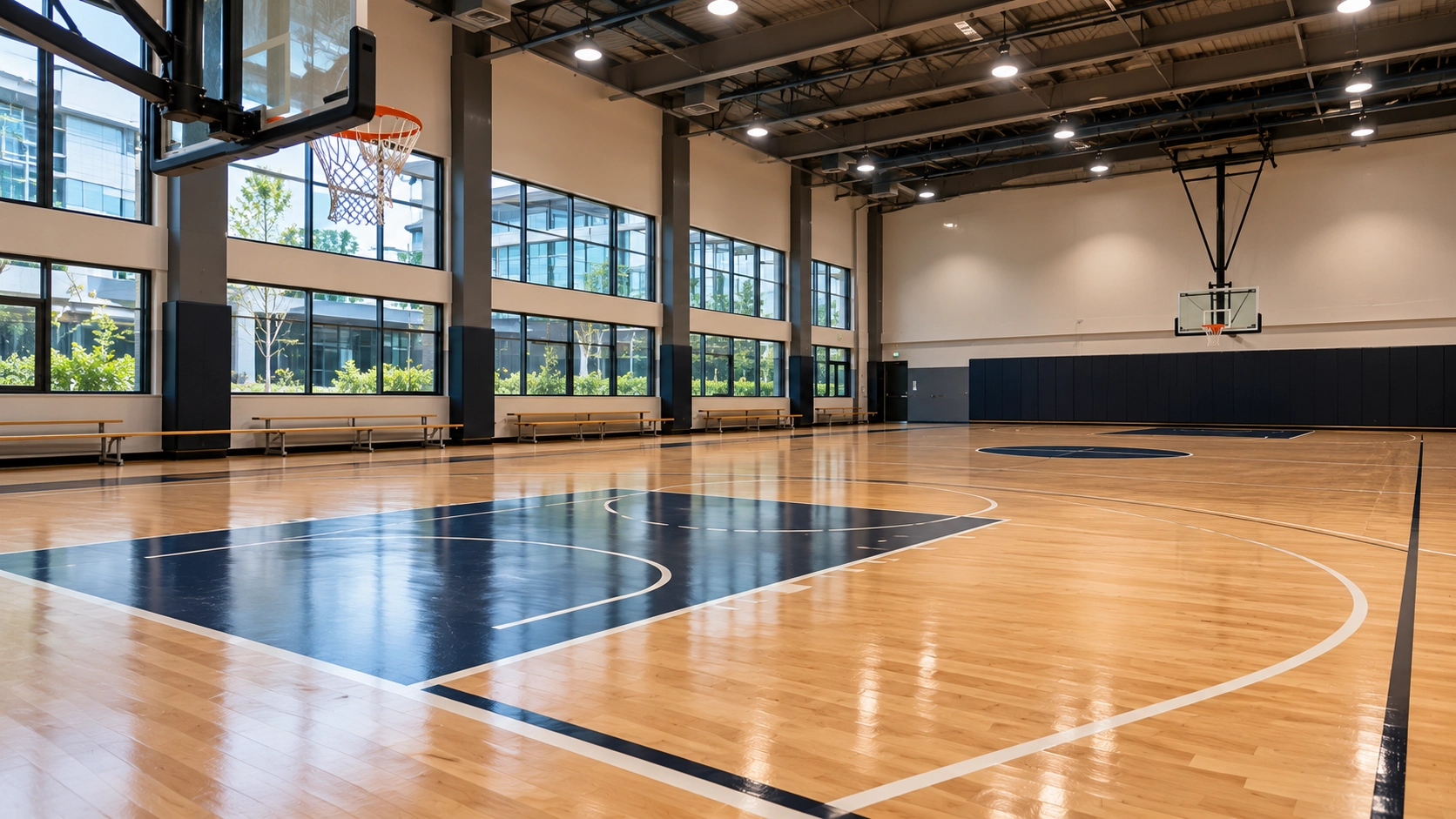
Timber is the traditional elite surface. The NBA and most high-profile international competitions use maple hardwood floors. They look extraordinary and provide performance characteristics that many players and coaches consider the gold standard.
In Singapore’s context, timber basketball courts have real limitations. Humidity is the primary concern. A maple hardwood court in a building without full climate control will expand, contract and potentially cup or gap as Singapore’s humidity cycles. Maintaining a timber court in top condition requires consistent air-conditioning, regular refinishing and periodic board replacement when sections are damaged.
Sports vinyl with a closed-cell foam shock-absorption layer provides FIBA-grade performance without the humidity vulnerability of timber. It handles Singapore’s tropical climate reliably. Maintenance involves regular sweeping and periodic professional cleaning rather than the surface refinishing and board treatment that timber requires.
For most Singapore schools, community clubs and private sports facilities, sports vinyl is the right specification. For premium professional-grade facilities where the aesthetic of timber is part of the proposition, we can discuss what is required to maintain a timber court properly in Singapore’s conditions.
Our sports flooring range covers the specifications appropriate for Singapore basketball courts, with shock absorption data and FIBA test results available for relevant products.
Court Dimensions and Line Marking
A full-size FIBA basketball court measures 28 metres by 15 metres. A 3×3 basketball court, which has become increasingly popular in Singapore’s community facilities and condominium developments, measures 15 metres by 11 metres. Both require precise court marking to regulation dimensions.
For school halls and community facilities where space is limited, a 3×3 court or a reduced half-court configuration is a realistic and widely used approach. Lexsure’s installation includes court marking in regulation colours and dimensions as part of the scope.
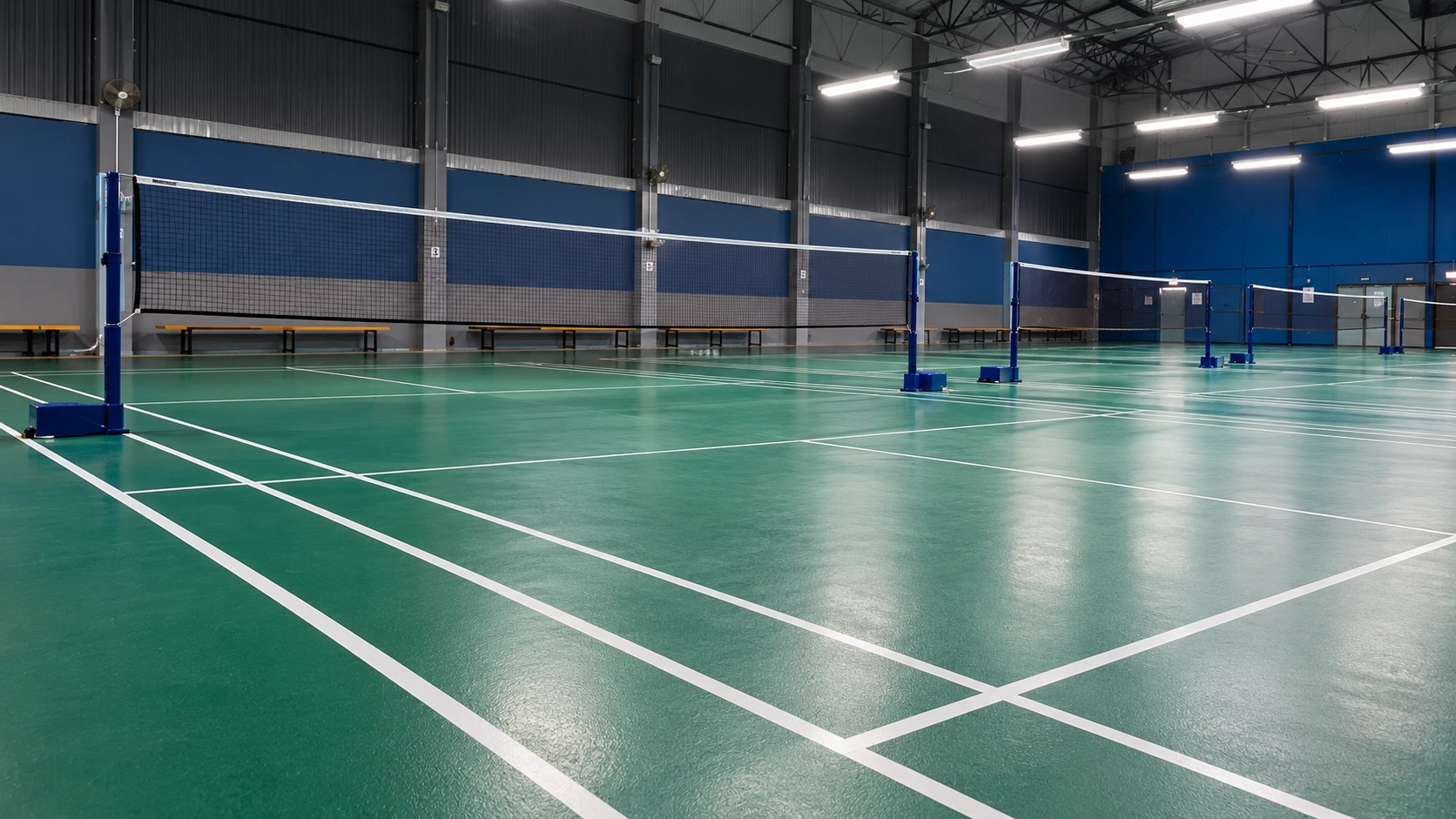
For multipurpose halls that need to accommodate basketball, badminton, volleyball and other sports, we design the court marking layout to allow all required sports to be played from the same surface with different markings visible simultaneously. This is standard practice in Singapore school and community sports facilities.
Resurfacing Existing Courts
Many Singapore basketball courts were installed 10 to 20 years ago on surfaces that are now worn, have reduced shock absorption or are visually degraded. Resurfacing an existing court is usually more cost-effective than a full replacement, provided the subfloor is structurally sound.
Our process for resurfacing starts with an assessment of the existing court condition, including checking for hollow sections, testing shock absorption performance and reviewing the integrity of existing court markings. We then recommend either full replacement or resurfacing depending on the findings. Contact us to arrange an assessment for your existing court.
Sport Singapore’s ActiveSG facility management resources provide guidance on maintenance standards for public sports facilities in Singapore that is a useful reference for private operators looking to align with national benchmarks.
Plan Your Basketball Court Project
Call +65 8299 7185 or visit us at WCEGA Tower, 21 Bukit Batok Crescent #12-78, Singapore. We cover site assessment, specification, supply and installation for new courts and resurfacing projects across Singapore. Open 7 days.